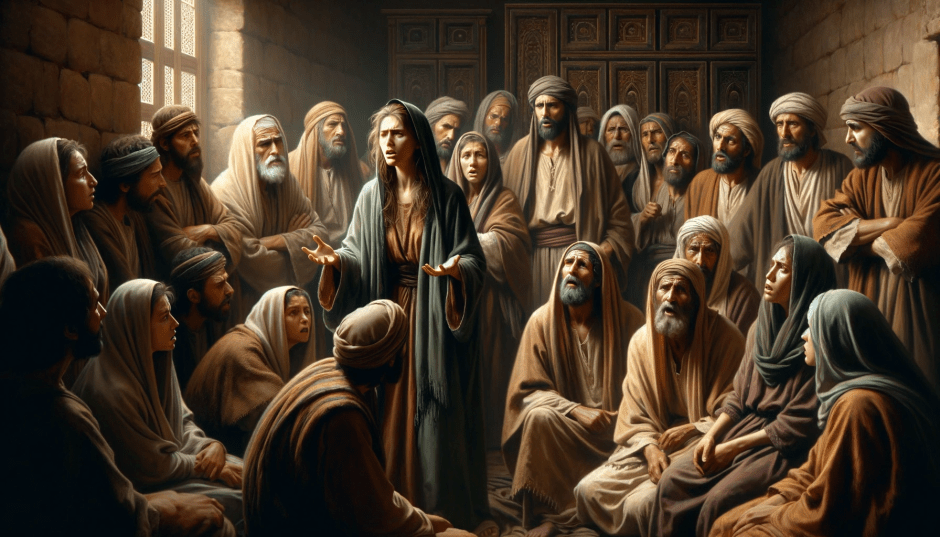
The Sabbath finished. Mary Magdalene, James’ mum Mary, and Salome bought spices to go and put on Jesus’ body. They went to the tomb first thing on the first weekday when the sun rose.
Talking together, they said, “Who will roll the stone from the tomb’s entrance?”
They looked up and saw the stone had already been rolled; it was very large.
They entered the tomb and were alarmed to see a man wearing a white robe sitting on the right.
He said, “Don’t be worried. Looking for Jesus the Nazarene who was killed on a cross? He’s awake, not here. Look at the spot where they placed him. Go and tell his disciples, and Peter, that Jesus is going before you to Galilee. Meet him there, like he told you.”
They left and ran from the tomb because they were scared and amazed. They didn’t tell anyone because they were afraid.
After Jesus rose on the morning of the first weekday, he appeared, firstly, to Mary Magdalene, who had had seven demons expelled from her.
Mary left and announced it to the people who had been with him. They were grieving and crying. The people didn’t believe he was alive and that Mary had seen him.
After this, Jesus appeared looking differently to two of the disciples walking out in the countryside. They went and told the others but were not believed.
Later, the eleven disciples were sitting at the table when Jesus appeared. He told them off for their lack of belief and hard hearts because they didn’t believe the people who saw him after he had risen.
He said to them, “Go across the whole world and announce the good news to everything that has been created. Whoever believes and is baptised will be saved, but whoever doesn’t believe will be guilty. These signs will go with the believers: In my name, they will send out demons and speak in new languages. They will lift snakes, and if they drink anything deadly, it won’t hurt them. They will place hands on sick people and heal them.”
After speaking to them, the Lord Jesus was lifted into heaven and sat at God’s right.
The disciples left and preached everywhere. The Lord was helping them and confirming the messages through relevant miracles.
Mark Chapter 16 Summary
After the Sabbath, Mary Magdalene, Mary the mother of James, and Salome brought spices to anoint Jesus’ body. Arriving at sunrise on the first day of the week, they found the tomb’s large stone rolled away. Inside, a man in white told them Jesus had risen and instructed them to tell his disciples and Peter that He would meet them in Galilee. Frightened yet amazed, they fled the tomb and said nothing initially due to fear. Jesus first appeared to Mary Magdalene, who told the others, but they did not believe her. Jesus then revealed Himself to two followers in the countryside and later to the eleven disciples, telling them off for their disbelief. He commanded them to preach the Gospel globally, promising salvation to believers and miracles to accompany them, such as expelling demons, speaking new languages, and healing. Jesus then ascended to heaven. The disciples spread the word, performing miracles as God confirmed their message.
Mark Chapter 16 Bible Study Questions and Answers
- Why do you think the women were initially afraid to speak about Jesus’ resurrection?
Answer: The women were likely overwhelmed by the supernatural event and feared disbelief or persecution. Their silence reflects our own hesitations to share our faith when faced with uncertainty or potentially being hurt or mocked. - How can we find the courage to share our faith when we are afraid, as the women initially were?
Answer: Taking inspiration from the women who eventually did share the news, we can pray for strength, seek support from fellow believers, and trust in the Holy Spirit to guide us in our sharing. - What does Jesus’ approach to His disciples, who were doubtful, teach us about dealing with doubt in our own lives?
Answer: Jesus’ caring yet straightforward approach with His disciples shows that while doubt is a natural part of faith, we must confront it and seek the truth. - How can the miracles that accompany believers (like healing and speaking in tongues) be understood and seen in modern Christian living?
Answer: These miracles can be seen as various forms of God’s work through believers, from physical healing to the less tangible, like offering comfort or understanding, and can be found through faith and prayer. - What does Jesus’ command to preach to “everything that has been created” say about the Christian message?
Answer: It emphasises that the good news is universal, meant for every person, regardless of background, and that as believers, we are called to be inclusive and share God’s love with all.
Mark Chapter 16 Explained
Mark Chapter 16 provides a powerful and victorious conclusion to the Gospel, depicting the resurrection of Jesus and the commands given to His disciples. The chapter begins with the women who followed Jesus, showing their commitment to care for Him even after His death. Their role as the first witnesses to the resurrection highlights the importance of faithfulness and the unexpected ways God can reveal Himself.
The initial reaction of fear and amazement from the women mirrors the human tendency to doubt and fear the unknown. Their silence is significant, representing the struggle between faith and fear—a theme that believers can understand as they navigate sharing their faith in a skeptical world. The angel’s message is clear and direct, highlighting that God’s promises are true and Jesus’s words are to be trusted.
Jesus first appears to Mary Magdalene, a person whom society had disregarded, showing His care and the transformative power of His presence. His appearance to the two followers on the road is a reminder that Jesus meets us in our everyday journeys, often in unexpected ways.
The encounter with the eleven disciples is particularly notable. Jesus tells them off for their disbelief, emphasising the necessity of faith. Yet, this is followed by a command, entrusting them with the task of spreading the good news. This shows that despite our flaws, we are called to serve a purpose in God’s plan.
The signs that follow believers serve as evidence of the divine power that accompanies the message of Christ. These signs are not just literal miracles but also represent the spiritual transformation and impact believers have in the world.
Finally, Jesus’ leaving for heaven and the disciples’ subsequent preaching underscores the transition from Jesus’ earthly ministry to the age of the Church, powered by the Holy Spirit.
In summary, Mark Chapter 16 is a call to action for all Christians. It invites us to experience the risen Christ, confront our doubts with faith, and carry the message of salvation to the world with the reassurance that God is with us.
To read the next chapters, you might like to follow or subscribe to this blog!
Continue exploring Mark 16
If you’d like to read Mark 16 in other translations, here are a few BibleHub links:
For a translation that aims to be word-for-word, try Mark 16 in the English Standard Version.
For a translation that aims to be more thought-for-thought, try Mark 16 in the New International Version.
For a translation that aims to communicate the overall meaning, try Mark 16 in the Contemporary English Version.
If you prefer to read the Bible in a hard-copy format, here are cheaper versions from Amazon:
[These are Amazon affiliate links which support the production of this blog]
For a translation that aims to be word-for-word, ESV Economy Bible
For a translation that aims to be more thought-for-thought, NIV, Economy Bible, Paperback: Accurate. Readable. Clear.
For a translation that aims to communicate the overall meaning, Holy Bible: Contemporary English Version
If you’d like to explore Mark in more depth, here are two commentaries I would recommend:
[These are Amazon affiliate links which support the production of this blog]
Easy to access commentaries that include life applications:
The NIV Application Commentary: Mark
Mark (The Story of God Bible Commentary)
For a commentary that goes into more depth:
The Gospel of Mark (The New International Commentary on the New Testament)








 Not My Life