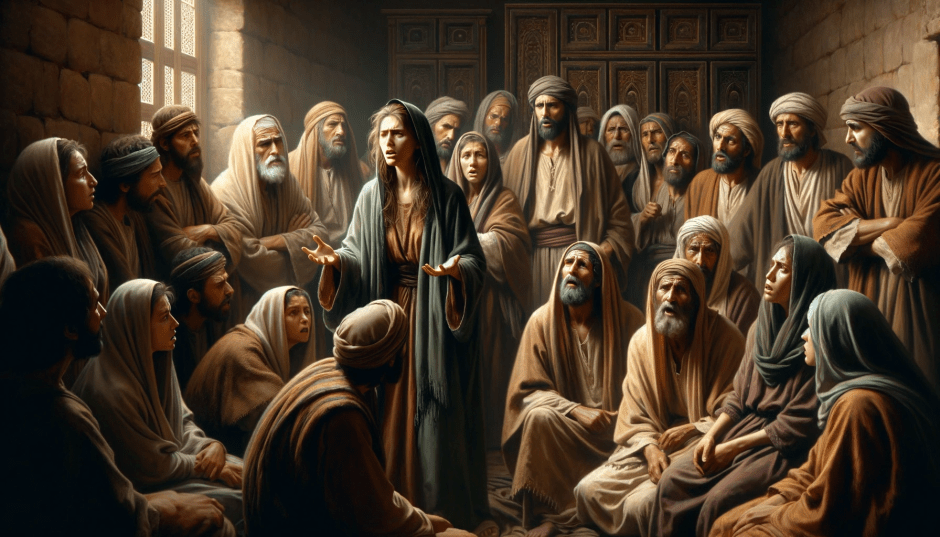
John Chapter 2 Simplified: Jesus makes wine, and chaos

The next day, there was a wedding in Cana, Galilee. Jesus’ mum, Jesus and his disciples were all there.

The wine was finished, and Jesus’ mum said to him, “They’re out of wine!”

Jesus replied, “What does this have to do with me, ma’am? My time hasn’t arrived.”

His mum said to the servants, “Do what he tells you to do.”

Six stone water jars were there for the Jew’s ceremonial cleaning. Each jar held about 80 or 120 litres.

Jesus said to the servants, “Fill the jars with water.” So the servants filled them to the top.

Jesus then instructed, “Take some out and give it to the party planner.” So they did.

The party planner tasted the water that had changed to wine. He didn’t know where it came from, but the servants did.

The party planner went to the groom and said, “People usually serve the good wine first and then the worse wine when they are drunk. You kept the good wine until now.”

This was the first miracle Jesus did at Cana, Galilee. It showed his glory, and his disciples trusted him.

Jesus then went down to Capernaum with his mum, brothers and disciples where they stayed for several days.

The Jews’ Passover was happening soon, so Jesus then went up to Jerusalem.

In the temple, Jesus found people selling cows, sheep and doves and found money exchangers sitting around. He made a rope whip and sent them out of the temple with the sheep and oxen. He  tipped money exchanger’s coins out and tipped over the tables.

He said to the dove sellers, “Take these away. Don’t make my Father’s house a market.”

Jesus’ disciples remembered the quote, ‘Passion for your house will consume me.’

The Jews said to Jesus, “Show us a miracle to prove you are allowed to do these things.”

Jesus replied, “Destroy the temple, and I will raise it up in three days.”

“This temple has taken 46 years so far to be built. How will you raise it up in three days?” the Jews asked.

But Jesus was talking about his body as the temple.

When Jesus rose from the dead, his followers remembered this conversation, and trusted what had been written and what Jesus had said.

While Jesus was in Jerusalem during the Passover festival, many people believed in him, watching the signs he was doing. Jesus, however, didn’t entrust himself to them because he knew them, and he didn’t need anyone to testify about people. He knew what was in people.

John Chapter 2 Summary

Jesus attends a wedding in Cana with his mum and disciples. When the wine runs out, his mum asks him to help. Jesus tells the servants to fill six large stone jars with water, which he turns into wine. Later, Jesus goes to Jerusalem for the Passover. At the temple, he finds sellers and money exchangers doing business. He drives them out with a whip, overturning their tables and declaring that the temple is his Father’s house, not a marketplace. When the Jews demand a sign showing his authority, Jesus speaks of destroying the temple and raising it in three days, referring to his death and resurrection. Many people trust in Jesus because of his miracles, but he remains cautious, understanding people’s nature and not entrusting himself to them.

John Chapter 2 Bible Study Questions and Answers

1. What does the miracle at the wedding teach us about Jesus’ relationship with his mum and his response to needs?
Answer: This event shows Jesus’ respect for his mum and his willingness to respond to human needs, even if it initially seems unnecessary in the grander scheme of things. It shows the importance of listening to and helping others.

2. How can we apply the lesson of turning water into wine in our daily lives?
Answer: This miracle shows Jesus’ power to change the ordinary into the extraordinary. It encourages us to trust in Jesus’ ability to bring change, even in seemingly hopeless situations.

3. What does Jesus’ clearing of the temple teach us about places of worship?
Answer: Jesus’ actions in the temple teach the importance of keeping worship spaces holy and free from business activities. It reminds us to respect and honour our places of worship, making sure they remain devoted to their purpose.

4. How can Jesus’ statement about destroying and raising the temple in three days enhance our understanding of his mission?
Answer: Jesus’ statement reveals the deeper meaning of his mission, which is his death and resurrection as the start of new faith. It calls us to think about the significance of Jesus’ sacrifice and resurrection in our own faith journey.

5. Why do you think Jesus did not entrust himself to the people who believed in him because of his miracles?
Answer: Jesus knew the nature of human belief and understood that faith based solely on miracles might not be deep or lasting. This teaches us to seek a deeper, more personal relationship with Jesus rather than relying only on signs and miracles for our faith.

John Chapter 2 Explained

John Chapter 2 begins with Jesus attending a wedding in Cana, Galilee. The event is an important moment in Jesus’ ministry because it’s his first recorded miracle. When the wine runs out, Jesus’ mum, Mary, brings the issue to his attention, showing her trust in his divine capabilities. Jesus’ first response, “My time hasn’t arrived,” suggests there was a timetable for his public ministry, yet he still responds to the immediate need by turning water into wine. This act shows his care and the importance of honouring his mum’s request. The miracle not only saves the wedding celebration but also reveals Jesus’ divine glory, further helping his disciples to trust in him.

The chapter then shifts to Jerusalem, where Jesus attends the Passover festival. Upon entering the temple, he encounters a scene of business where people were selling animals for sacrifices and money exchangers were conducting business. This sight provoked Jesus to take action. He makes a whip and chases out the sellers and animals, overturns the tables of the money changers, and tells them off for turning his Father’s house into a marketplace. This clearing of the temple shows Jesus’ passion for keeping worship pure, and his authority over the temple. It serves as a call to respect and keep the purity of places dedicated to God.

When the Jews challenge Jesus, demanding a sign to prove he was allowed to chase them out, he vaguely replies, “Destroy this temple, and I will raise it up in three days.” This confuses the Jews, who take it literally, not understanding that Jesus is talking about his body. His prophecy refers to his death and resurrection. This conversation comes before the sacrifice Jesus would make and his victory over death, a truth his disciples only fully understand after his resurrection.

Throughout the Passover in Jerusalem, many people see Jesus’ miracles and believe in him. However, Jesus does not fully entrust himself to them, knowing that trust based just on signs isn’t very deep. He understands the complexities and often shallowness of human belief. This highlights Jesus’ sensitivity and the need for a deeper, more real faith that goes beyond seeing miracles to believe.

To read the next chapters, you might like to follow or subscribe to this blog!


Continue exploring John 2

If you’d like to read John xx in other translations, here are a few BibleHub links:
For a translation that aims to be word-for-word, try John 2 in the English Standard Version.
For a translation that aims to be more thought-for-thought, try John 2 in the New International Version.
For a translation that aims to communicate the overall meaning, try John 2 in the Contemporary English Version.

If you prefer to read the Bible in a hard-copy format, here are cheaper versions from Amazon:
[These are Amazon affiliate links which support the production of this blog]
For a translation that aims to be word-for-word, ESV Economy Bible
For a translation that aims to be more thought-for-thought, NIV, Economy Bible, Paperback: Accurate. Readable. Clear.
For a translation that aims to communicate the overall meaning, Holy Bible: Contemporary English Version

If you’d like to explore John in more depth, here are two commentaries I would recommend:
[These are Amazon affiliate links which support the production of this blog]
Easy to access commentaries that include life applications:
The NIV Application Commentary: John
Mark (The Story of God Bible Commentary)
For a commentary that goes into more depth:
The Gospel of John (The New International Commentary on the New Testament)


John Chapter 1 Simplified: Who is Jesus?

The message was at the start and was connected with God and the message was God.

Jesus was with God at the start.

Everything was made by God. Nothing that has been made was made without him. Life was in God and life was the light of all people. The light shines through the darkness and darkness didn’t stop it.

A man arrived name John who was sent from God. He came to give witness about the light so everyone would trust because of what he said. He wasn’t the light but witnessed about the light.

The actual light, who lights every person, was coming to the world. He was in the world and the world was created by him but the world didn’t understand him. He came to his own people and they didn’t accept him, but many other accepted him. He gave those that trusted in his name the right to become children of God. They were not born of lineage or people’s wishes or the husband’s wishes, but of God. The word became a person and settled among us. We saw his glory; glory uniquely from the Father that is full of grace and truth.

John witnessed about him and yelled out, “This was who I was talking about. The person coming after me is greater than me because he existed first.”

We have received so much kindness from his completeness. Because the law was given through Moses while kindness and truth was given through Jesus Christ. No one has ever seen God, but Jesus, who is in the Father’s heart, reveals things.

This was John’s testimony.

The Jews sent priests and Levites from Jerusalem to ask him, “Who are you?”

John did not deny, and told them, “I’m not the Christ.”

“Then who are you?” they asked. “Are you Elijah?”

“I’m not.”

“Are you the Prophet?”

“No,” he answered.

“Who are you? Give us an answer to take back to those who sent us,” they said. “What do you say about yourself?”

John replied, “I’m yelling in the wilderness, ‘Straighten the way for the Lord’, just like Isaiah the prophet said.”

The priests had been sent from the Pharisees, and they asked John, “Why are you baptising if you are not the Christ or Elijah or the Prophet?”

“I baptise with water,” John answered. “You are standing near someone who you don’t know. There is a person coming after me. I’m not worthy to even untie his shoes.”

This all happened in Bethany, across the Jordan river, where John was baptising.

The next day, John saw Jesus coming and said, “Look, it’s the Lamb of God who takes the world’s sin! This is who I was talking about when I said, ‘A man is coming after me who is greater than me, because he existed first.’ I didn’t know him, but I came baptising so he could be revealed to Israel.”

John testified, “I saw the Spirit come down from heaven like a dove and remain on him.

I didn’t know him, but the one who sent me to baptise told me, ‘The one who baptises with the Holy Spirit is the one you see the Spirit descend and remain on him. I see and testify that this is God’s chosen one.”

The next day, John was standing with two disciples. John looked at Jesus as he walked by and said, “Look, the Lamb of God”

The two disciples heard him and followed Jesus.

Jesus turned around and saw them following. He asked, “What are you looking for?”

They replied, “Teacher, where are you staying?

Jesus said, “Come and see.” So they went and saw where he was staying, and stayed with him for the day, from around 10 o’clock.

Andrew, Simon Peter’s brother, was one of the two who listened to John and followed him. He found his brother Simon and said, “We have found the Christ!”

He brought Simon to Jesus. Jesus looked at him and said, “You are Simon, John’s son. You will be called Peter.”

Jesus wanted to leave the next day for Galilee. He found Phillip and said, “Follow me.”

Phillip was from Bethsaida, the same town as Andrew and Peter. Phillip found Nathaniel and said, “We’ve found the person who Moses and the prophets wrote about. It’s Jesus, Jospeh’s son, from Nazareth.”

Nathaniel replied, “Can anything good come out of Nazareth?”

“Come, see!” Phillip said.

Jesus saw Nathanial coming and said to him, “Look, an Israelite with no hidden motives.”

Nathaniel replied, “Where do you know me from?”
“I saw you before Phillip called you under the fig tree,” Jesus said.

Nathaniel said, “Teacher, you are the God’s son! You are Israel’s king.”

“You trust me because I said I saw you under the fig tree?” Jesus replied. “You will see things greater than that. I’m honestly telling you that you will see the sky open and God’s angels going up and down to the Son of Man.”

John Chapter 1 Summary

The chapter begins by declaring that everything was made through Jesus, and in Him was life and light that darkness could not overcome. John the Baptist is introduced as a witness to this light, preparing the way for Jesus. Despite being the true light, many did not recognise or accept Jesus, but those who did were given the right to become God’s children.

John the Baptist denies being the Messiah, Elijah, or the Prophet. Instead, he says he is a voice preparing the way for the Lord. He baptises with water, but explains there is one greater who will baptise with the Holy Spirit. Jesus is later revealed by John as the Lamb of God who takes away the sin of the world. As Jesus begins His ministry, He calls His first disciples, including Andrew, Simon Peter, Philip, and Nathanael. They see Him as the Messiah and the Son of God, starting His ministry.

John Chapter 1 Bible Study Questions and Answers

1. What does it mean for Jesus to be the “Word”?
Answer: Jesus as the “Word” highlights His divine nature. Jesus is not just a historical person but the very foundation of life and light. Understanding this can deepen one’s appreciation for Jesus’ authority and presence their life.

2. How can we reflect the light of Jesus in our lives?
Answer: Reflecting the light of Jesus involves living out His teachings by showing kindness, love, and grace to others. It means being a “witness” to His truth and holding the values of God’s kingdom in our behaviours and decisions.

3. Why is it significant that John the Baptist emphasised he was not the Messiah?
Answer: John the Baptist’s humility and clear identification of his role illustrates the importance of recognising our place in God’s plan. It teaches the value of pointing others to Jesus rather than seeking personal glory.

4. How can we prepare the Lord’s way today, similar to John the Baptist’s mission?
Answer: We can prepare the Lord’s way by sharing the gospel, serving and loving others, and creating environments where others can encounter Jesus. This involves both talking about Jesus and living as a reflection of His teachings and character.

5. How can the first disciples’ immediate responses to Jesus’ call inspire us?
Answer: The first disciples’ readiness to follow Jesus demonstrates the importance of responsiveness and obedience in our faith journey. It challenges us to prioritise our relationship with Jesus and to be willing to leave behind our comfort zones to follow Him.

John Chapter 1 Explained

John Chapter 1 sets the scene, both the story and theology, for the rest of the book. It begins with a prologue that identifies Jesus as the Word who was with God and was God from the beginning. This describes his divine nature and pre-existence, indicating that all things were created through him. The imagery of Jesus as the light of men that darkness cannot overcome is a powerful illustration for his illuminating presence in a fallen world.

We are then introduced to John the Baptist, who serves as a pivotal figure in preparing the way for Jesus. John’s role is to bear witness to the light—he himself is not the light but a messenger. This distinction is crucial as it highlights the humility and purpose of John’s ministry which is pointing others to Christ. John’s baptism with water is contrasted with Jesus’ future baptism with the Holy Spirit, showing the transformative work that Jesus would accomplish.

Despite Jesus being the true light, the chapter explains that he was not recognised or accepted by many of his own people (Jews). However, those who did receive him were given the right to become children of God, showing the inclusiveness of Jesus’ mission.

John the Baptist’s testimony about Jesus as the Lamb of God who takes away the sin of the world is central to understanding Jesus’ sacrificial role. Jesus’ mission was to pay for humanity’s sins. John’s recognition of Jesus as someone greater points to the shift from the old agreement people had with God to the new one established through Jesus.

There is then a story pivot to Jesus calling the first disciples. Jesus’ invitation to “come and see” is an open call to all. The immediate and enthusiastic responses of Andrew, Simon Peter, Philip, and Nathanael show the compelling and trustworthy presence of Jesus. Their recognition of Jesus as the saviour and God’s son sets a tone for the followers that will continue throughout the Gospel.

Nathanael’s shows some initial reluctance, hearing that Jesus was from Nazareth, but then he acknowledges Jesus as God’s son. This shows the transformative power of meeting Jesus. The chapter concludes with Jesus’ promise of revealing many great things, indicating that the journey with Jesus is one of continuous learning, discovery and faith that strengthens.

To read the next chapters, you might like to follow or subscribe to this blog!


Continue exploring John 1

If you’d like to read John 1 in other translations, here are a few BibleHub links:
For a translation that aims to be word-for-word, try John 1 in the English Standard Version.
For a translation that aims to be more thought-for-thought, try John 1 in the New International Version.
For a translation that aims to communicate the overall meaning, try John 1 in the Contemporary English Version.

If you prefer to read the Bible in a hard-copy format, here are cheaper versions from Amazon:
[These are Amazon affiliate links which support the production of this blog]
For a translation that aims to be word-for-word, ESV Economy Bible
For a translation that aims to be more thought-for-thought, NIV, Economy Bible, Paperback: Accurate. Readable. Clear.
For a translation that aims to communicate the overall meaning, Holy Bible: Contemporary English Version

If you’d like to explore John in more depth, here are two commentaries I would recommend:
[These are Amazon affiliate links which support the production of this blog]
Easy to access commentaries that include life applications:
The NIV Application Commentary: John
For a commentary that goes into more depth:
The Gospel of John (The New International Commentary on the New Testament)

Psalm 37 Prayer: Trusting God’s Timing and Goodness

Heavenly Father,

In the quiet of our hearts, we seek Your wisdom and trust in Your timing. Help us to trust in You and do good, to dwell in the land and enjoy safe pasture. Let us delight in You, Lord, and You will give us the desires of our hearts.

Commit our way to You; trust in You, and You will do this: You will make our righteous reward shine like the dawn, our vindication like the noonday sun. Help us to be still before You and wait patiently for You; do not fret when people succeed in their ways, when they carry out their wicked schemes.

Refrain from anger and turn from wrath; do not fret—it leads only to evil. For those who are evil will be destroyed, but those who hope in the Lord will inherit the land. A little while, and the wicked will be no more; though you look for them, they will not be found.

But the meek will inherit the land and enjoy peace and prosperity. The salvation of the righteous comes from You; You are their stronghold in times of trouble. Help us to trust in You, Lord, and follow Your paths, for in Your presence, we find peace and true joy.

In Jesus’ name, we pray.

Amen.

To read more prayers, you might like to follow or subscribe to this blog!


Continue exploring Psalm 37

If you’d like to read Psalm 37, here are a few BibleHub links:
For a translation that aims to be word-for-word, try Psalm 37 in the English Standard Version.
For a translation that aims to be more thought-for-thought, try Psalm 37 in the New International Version.
For a translation that aims to communicate the overall meaning, try Psalm 37 in the Contemporary English Version.

If you prefer to read the Bible in a hard-copy format, here are cheaper versions from Amazon:
[These are Amazon affiliate links which support the production of this blog]
For a translation that aims to be word-for-word, ESV Economy Bible
For a translation that aims to be more thought-for-thought, NIV, Economy Bible, Paperback: Accurate. Readable. Clear.
For a translation that aims to communicate the overall meaning, Holy Bible: Contemporary English Version

Psalm 100 Prayer: Joyful Service and Enduring Faith

Heavenly Father,

With joyful hearts, we come before You, singing praises to Your name. We serve You with gladness, entering Your gates with thanksgiving and Your courts with praise. We give thanks to You and praise Your name.

For You are good, Lord. Your unfailing love continues forever, and Your faithfulness extends to all generations. You have made us, and we are Yours. We are Your people, the sheep of Your pasture.

In every moment, let us remember Your goodness and the joy of Your presence. Teach us to serve You with gladness, to embrace each day with a heart of gratitude. May our lives reflect Your love and faithfulness, spreading Your joy to those around us.

In Jesus’ name, we pray.

Amen.


To read more prayers, you might like to follow or subscribe to this blog!


Continue exploring Psalm 100

If you’d like to read Psalm 100, here are a few BibleHub links:
For a translation that aims to be word-for-word, try Psalm 100 in the English Standard Version.
For a translation that aims to be more thought-for-thought, try Psalm 100 in the New International Version.
For a translation that aims to communicate the overall meaning, try Psalm 100 in the Contemporary English Version.

If you prefer to read the Bible in a hard-copy format, here are cheaper versions from Amazon:
[These are Amazon affiliate links which support the production of this blog]
For a translation that aims to be word-for-word, ESV Economy Bible
For a translation that aims to be more thought-for-thought, NIV, Economy Bible, Paperback: Accurate. Readable. Clear.
For a translation that aims to communicate the overall meaning, Holy Bible: Contemporary English Version

Psalm 34 Prayer: Praising God Through Life’s Challenges

Heavenly Father,

In the multitude of life’s challenges, we turn to You, praising Your name always. We sought You, Lord, and You answered us; You delivered us from all our fears. Those who look to You are radiant; their faces are never covered with shame.

This poor soul cried, and You heard us, Lord, and saved us from every trouble. The angel of the Lord encamps around those who fear Him, and He delivers them. O taste and see that the Lord is good; blessed is the one who takes refuge in Him.

Fear the Lord, you His holy people, for those who fear Him lack nothing. Young lions may grow weak and hungry, but those who seek the Lord lack no good thing. Lord, teach us to fear You and to seek Your face always.

Keep our tongues from evil and our lips from speaking deceit. Let us turn from evil and do good; let us seek peace and pursue it. For Your eyes, Lord, are on the righteous, and Your ears are attentive to their cry.

In our struggles and joys, let us remember Your presence and providence. In Your righteousness, lead us and guide our steps. May we always find our strength and refuge in You, O Lord.

In Jesus’ name, we pray.

Amen.

To read more prayers, you might like to follow or subscribe to this blog!


Continue exploring Psalm 34

If you’d like to read Psalm 34, here are a few BibleHub links:
For a translation that aims to be word-for-word, try Psalm 34 in the English Standard Version.
For a translation that aims to be more thought-for-thought, try Psalm 34 in the New International Version.
For a translation that aims to communicate the overall meaning, try Psalm 34 in the Contemporary English Version.

If you prefer to read the Bible in a hard-copy format, here are cheaper versions from Amazon:
[These are Amazon affiliate links which support the production of this blog]
For a translation that aims to be word-for-word, ESV Economy Bible
For a translation that aims to be more thought-for-thought, NIV, Economy Bible, Paperback: Accurate. Readable. Clear.
For a translation that aims to communicate the overall meaning, Holy Bible: Contemporary English Version

Psalm 103 Prayer: Celebrating God’s Eternal Love

Heavenly Father,

In the vast canvas of Your love, we find endless reasons to praise You. You forgive all our sins and heal all our diseases. You redeem our lives from the pit and crown us with love and compassion. You satisfy our desires with good things, renewing our youth like the eagle’s.

Lord, as high as the heavens are above the earth, so great is Your love for those who fear You. As far as the east is from the west, so far have You removed our transgressions from us. Like a father has compassion on his children, so You have compassion on those who fear You.

You know how we are formed, remembering that we are dust. Our days are like grass; we flourish like a flower of the field, then the wind blows over it and it is gone. But Your love, O Lord, is from everlasting to everlasting on those who fear You, and Your righteousness with their children’s children.

Let us always remember Your precepts and follow Your paths. In Your righteousness and love, guide us each day. In the midst of life’s fleeting moments, let Your eternal love be our constant and our hope.

In Jesus’ name, we pray.

Amen.

To read more prayers, you might like to follow or subscribe to this blog!


Continue exploring Psalm 103

If you’d like to read Psalm 103, here are a few BibleHub links:
For a translation that aims to be word-for-word, try Psalm 103 in the English Standard Version.
For a translation that aims to be more thought-for-thought, try Psalm 103 in the New International Version.
For a translation that aims to communicate the overall meaning, try Psalm 103 in the Contemporary English Version.

If you prefer to read the Bible in a hard-copy format, here are cheaper versions from Amazon:
[These are Amazon affiliate links which support the production of this blog]
For a translation that aims to be word-for-word, ESV Economy Bible
For a translation that aims to be more thought-for-thought, NIV, Economy Bible, Paperback: Accurate. Readable. Clear.
For a translation that aims to communicate the overall meaning, Holy Bible: Contemporary English Version

Psalm 27 Prayer: Be My Guiding Light In Life’s Shadows

Heavenly Father,

In the quiet of this moment, I lift my heart to You. You are my light and my salvation, the stronghold of my life, and I seek refuge in Your embrace. In a world filled with shadows, Your light guides my steps. When fear tries to grip my heart, Your love casts it away. I am comforted by the thought of dwelling in Your house all the days of my life, gazing upon Your beauty and seeking You in Your temple.

Lord, hear my voice when I call; be merciful and answer me. My heart whispers of Your pursuit: “Seek His face.” Your presence, Lord, I seek. Do not hide Your face from me, do not turn Your servant away in anger. You have been my helper; do not reject me or forsake me, God my Saviour.

Even if my father and mother abandon me, I trust that You will hold me close. Teach me Your way, Lord; lead me on a straight path because of my oppressors. Do not hand me over to the will of my foes, for false witnesses rise up against me, spouting malicious accusations.

I remain confident of this: I will see the goodness of the Lord in the land of the living. Wait for the Lord; be strong and take heart and wait for the Lord.

In Your light, I see the shadows in my own heart. I confess the times I’ve turned away from Your love, choosing fear over faith. Forgive me, Lord, and guide me back to Your path of righteousness.

In my own struggles, I ask for Your strength. Help me to trust in Your timing and Your plan, to be patient in the waiting and strong in the face of uncertainty. Equip me, Lord, to be a beacon of Your love and peace to those around me.

I pray for those who are lost, those who walk in darkness without the light of Your love. Use me, Lord, to reach out to them, to show them Your compassion and grace. May my life reflect Your love and bring others into Your light.

And in all things, I give thanks. Thank you for Your unending love, for the peace that surpasses all understanding, and for the hope that is found in You. You are my light and my salvation, and in You, I find everything I need.

Amen.

To read more prayers, you might like to follow or subscribe to this blog!


Continue exploring Psalm 27

If you’d like to read Psalm 27, here are a few BibleHub links:
For a translation that aims to be word-for-word, try Psalm 27 in the English Standard Version.
For a translation that aims to be more thought-for-thought, try Psalm 27 in the New International Version.
For a translation that aims to communicate the overall meaning, try Psalm 27 in the Contemporary English Version.

If you prefer to read the Bible in a hard-copy format, here are cheaper versions from Amazon:
[These are Amazon affiliate links which support the production of this blog]
For a translation that aims to be word-for-word, ESV Economy Bible
For a translation that aims to be more thought-for-thought, NIV, Economy Bible, Paperback: Accurate. Readable. Clear.
For a translation that aims to communicate the overall meaning, Holy Bible: Contemporary English Version

Psalm 139 Prayer: In Your Light

Heavenly Father,

In the vastness of Your creation, we stand in awe of Your knowledge and presence. You have searched us, Lord, and You know us. You understand our thoughts from afar, intricately weaving us in our mother’s womb.

Before a word is on our tongue, You know it completely, O Lord. Such knowledge is too wonderful for us, too lofty for us to attain. Where can we go from Your Spirit? Where can we flee from Your presence? If we rise on the wings of the dawn or settle on the far side of the sea, even there Your hand will guide us, Your right hand will hold us fast.

You created our inmost being; You knit us together. We praise You because we are fearfully and wonderfully made; Your works are wonderful, we know that full well. Even the darkness will not be dark to You; the night will shine like the day, for darkness is as light to You.

Lead us in the way everlasting, O Lord. In Your love and wisdom, guide our paths. Help us to always remember that we are never hidden from Your sight, and in Your light, we find our true selves.

In Jesus’ name, we pray.

Amen.

To read more prayers, you might like to follow or subscribe to this blog!


Continue exploring Psalm 139

If you’d like to read Psalm 139, here are a few BibleHub links:
For a translation that aims to be word-for-word, try Psalm 139 in the English Standard Version.
For a translation that aims to be more thought-for-thought, try Psalm 139 in the New International Version.
For a translation that aims to communicate the overall meaning, try Psalm 139 in the Contemporary English Version.

If you prefer to read the Bible in a hard-copy format, here are cheaper versions from Amazon:
[These are Amazon affiliate links which support the production of this blog]
For a translation that aims to be word-for-word, ESV Economy Bible
For a translation that aims to be more thought-for-thought, NIV, Economy Bible, Paperback: Accurate. Readable. Clear.
For a translation that aims to communicate the overall meaning, Holy Bible: Contemporary English Version

Psalm 91 Prayer: Prayer For Protection And Peace

Dear Lord,

In the stillness of our hearts, we come before You, seeking the comfort of Your presence. You are our refuge, our fortress, in You we find trust and peace. As we walk through the shadows of life, we cling to Your promise of protection and safety. Your faithfulness, like a shield, guards our hearts and minds.

In the quiet of the night, when fears try to steal our peace, remind us that we need not fear the terrors of the dark, nor the uncertainties of the day. You are our guardian, ever-watchful, ever-present. Under Your wings, we find a haven, a place where fear has no hold.

We are grateful for Your promise that when we call on You, You will answer. In times of trouble, You are there, delivering us, honouring us with Your love and care. Lord, let us dwell in the knowledge that with You, we find long life and salvation.

Help us to rest in the assurance of Your protection, to live boldly and without fear. May we always remember that in You, we find strength and a safe harbour, now and forevermore.

Amen.

To read more prayers, you might like to follow or subscribe to this blog!


Continue exploring Psalm 91

If you’d like to read Psalm 91, here are a few BibleHub links:
For a translation that aims to be word-for-word, try Psalm 91 in the English Standard Version.
For a translation that aims to be more thought-for-thought, try Psalm 91 in the New International Version.
For a translation that aims to communicate the overall meaning, try Psalm 91 in the Contemporary English Version.

If you prefer to read the Bible in a hard-copy format, here are cheaper versions from Amazon:
[These are Amazon affiliate links which support the production of this blog]
For a translation that aims to be word-for-word, ESV Economy Bible
For a translation that aims to be more thought-for-thought, NIV, Economy Bible, Paperback: Accurate. Readable. Clear.
For a translation that aims to communicate the overall meaning, Holy Bible: Contemporary English Version

Mark Chapter 16 Simplified: No one believes Jesus is alive

The Sabbath finished. Mary Magdalene, James’ mum Mary, and Salome bought spices to go and put on Jesus’ body. They went to the tomb first thing on the first weekday when the sun rose.

Talking together, they said, “Who will roll the stone from the tomb’s entrance?”

They looked up and saw the stone had already been rolled; it was very large.

They entered the tomb and were alarmed to see a man wearing a white robe sitting on the right.

He said, “Don’t be worried. Looking for Jesus the Nazarene who was killed on a cross? He’s awake, not here. Look at the spot where they placed him. Go and tell his disciples, and Peter, that Jesus is going before you to Galilee. Meet him there, like he told you.”

They left and ran from the tomb because they were scared and amazed. They didn’t tell anyone because they were afraid.

After Jesus rose on the morning of the first weekday, he appeared, firstly, to Mary Magdalene, who had had seven demons expelled from her.

Mary left and announced it to the people who had been with him. They were grieving and crying. The people didn’t believe he was alive and that Mary had seen him.

After this, Jesus appeared looking differently to two of the disciples walking out in the countryside. They went and told the others but were not believed.

Later, the eleven disciples were sitting at the table when Jesus appeared. He told them off for their lack of belief and hard hearts because they didn’t believe the people who saw him after he had risen.

He said to them, “Go across the whole world and announce the good news to everything that has been created. Whoever believes and is baptised will be saved, but whoever doesn’t believe will be guilty. These signs will go with the believers: In my name, they will send out demons and speak in new languages. They will lift snakes, and if they drink anything deadly, it won’t hurt them. They will place hands on sick people and heal them.”

After speaking to them, the Lord Jesus was lifted into heaven and sat at God’s right.

The disciples left and preached everywhere. The Lord was helping them and confirming the messages through relevant miracles.

Mark Chapter 16 Summary

After the Sabbath, Mary Magdalene, Mary the mother of James, and Salome brought spices to anoint Jesus’ body. Arriving at sunrise on the first day of the week, they found the tomb’s large stone rolled away. Inside, a man in white told them Jesus had risen and instructed them to tell his disciples and Peter that He would meet them in Galilee. Frightened yet amazed, they fled the tomb and said nothing initially due to fear. Jesus first appeared to Mary Magdalene, who told the others, but they did not believe her. Jesus then revealed Himself to two followers in the countryside and later to the eleven disciples, telling them off for their disbelief. He commanded them to preach the Gospel globally, promising salvation to believers and miracles to accompany them, such as expelling demons, speaking new languages, and healing. Jesus then ascended to heaven. The disciples spread the word, performing miracles as God confirmed their message.

Mark Chapter 16 Bible Study Questions and Answers

  1. Why do you think the women were initially afraid to speak about Jesus’ resurrection?
    Answer: The women were likely overwhelmed by the supernatural event and feared disbelief or persecution. Their silence reflects our own hesitations to share our faith when faced with uncertainty or potentially being hurt or mocked.
  2. How can we find the courage to share our faith when we are afraid, as the women initially were?
    Answer: Taking inspiration from the women who eventually did share the news, we can pray for strength, seek support from fellow believers, and trust in the Holy Spirit to guide us in our sharing.
  3. What does Jesus’ approach to His disciples, who were doubtful, teach us about dealing with doubt in our own lives?
    Answer: Jesus’ caring yet straightforward approach with His disciples shows that while doubt is a natural part of faith, we must confront it and seek the truth.
  4. How can the miracles that accompany believers (like healing and speaking in tongues) be understood and seen in modern Christian living?
    Answer: These miracles can be seen as various forms of God’s work through believers, from physical healing to the less tangible, like offering comfort or understanding, and can be found through faith and prayer.
  5. What does Jesus’ command to preach to “everything that has been created” say about the Christian message?
    Answer: It emphasises that the good news is universal, meant for every person, regardless of background, and that as believers, we are called to be inclusive and share God’s love with all.

Mark Chapter 16 Explained

Mark Chapter 16 provides a powerful and victorious conclusion to the Gospel, depicting the resurrection of Jesus and the commands given to His disciples. The chapter begins with the women who followed Jesus, showing their commitment to care for Him even after His death. Their role as the first witnesses to the resurrection highlights the importance of faithfulness and the unexpected ways God can reveal Himself.

The initial reaction of fear and amazement from the women mirrors the human tendency to doubt and fear the unknown. Their silence is significant, representing the struggle between faith and fear—a theme that believers can understand as they navigate sharing their faith in a skeptical world. The angel’s message is clear and direct, highlighting that God’s promises are true and Jesus’s words are to be trusted.

Jesus first appears to Mary Magdalene, a person whom society had disregarded, showing His care and the transformative power of His presence. His appearance to the two followers on the road is a reminder that Jesus meets us in our everyday journeys, often in unexpected ways.

The encounter with the eleven disciples is particularly notable. Jesus tells them off for their disbelief, emphasising the necessity of faith. Yet, this is followed by a command, entrusting them with the task of spreading the good news. This shows that despite our flaws, we are called to serve a purpose in God’s plan.

The signs that follow believers serve as evidence of the divine power that accompanies the message of Christ. These signs are not just literal miracles but also represent the spiritual transformation and impact believers have in the world.

Finally, Jesus’ leaving for heaven and the disciples’ subsequent preaching underscores the transition from Jesus’ earthly ministry to the age of the Church, powered by the Holy Spirit.

In summary, Mark Chapter 16 is a call to action for all Christians. It invites us to experience the risen Christ, confront our doubts with faith, and carry the message of salvation to the world with the reassurance that God is with us.

To read the next chapters, you might like to follow or subscribe to this blog!


Continue exploring Mark 16

If you’d like to read Mark 16 in other translations, here are a few BibleHub links:
For a translation that aims to be word-for-word, try Mark 16 in the English Standard Version.
For a translation that aims to be more thought-for-thought, try Mark 16 in the New International Version.
For a translation that aims to communicate the overall meaning, try Mark 16 in the Contemporary English Version.

If you prefer to read the Bible in a hard-copy format, here are cheaper versions from Amazon:
[These are Amazon affiliate links which support the production of this blog]
For a translation that aims to be word-for-word, ESV Economy Bible
For a translation that aims to be more thought-for-thought, NIV, Economy Bible, Paperback: Accurate. Readable. Clear.
For a translation that aims to communicate the overall meaning, Holy Bible: Contemporary English Version

If you’d like to explore Mark in more depth, here are two commentaries I would recommend:
[These are Amazon affiliate links which support the production of this blog]
Easy to access commentaries that include life applications:
The NIV Application Commentary: Mark
Mark (The Story of God Bible Commentary)
For a commentary that goes into more depth:
The Gospel of Mark (The New International Commentary on the New Testament)